JULY 2026 REPORT (7-9PM)
JULY 2026 REPORT (7-9PM)
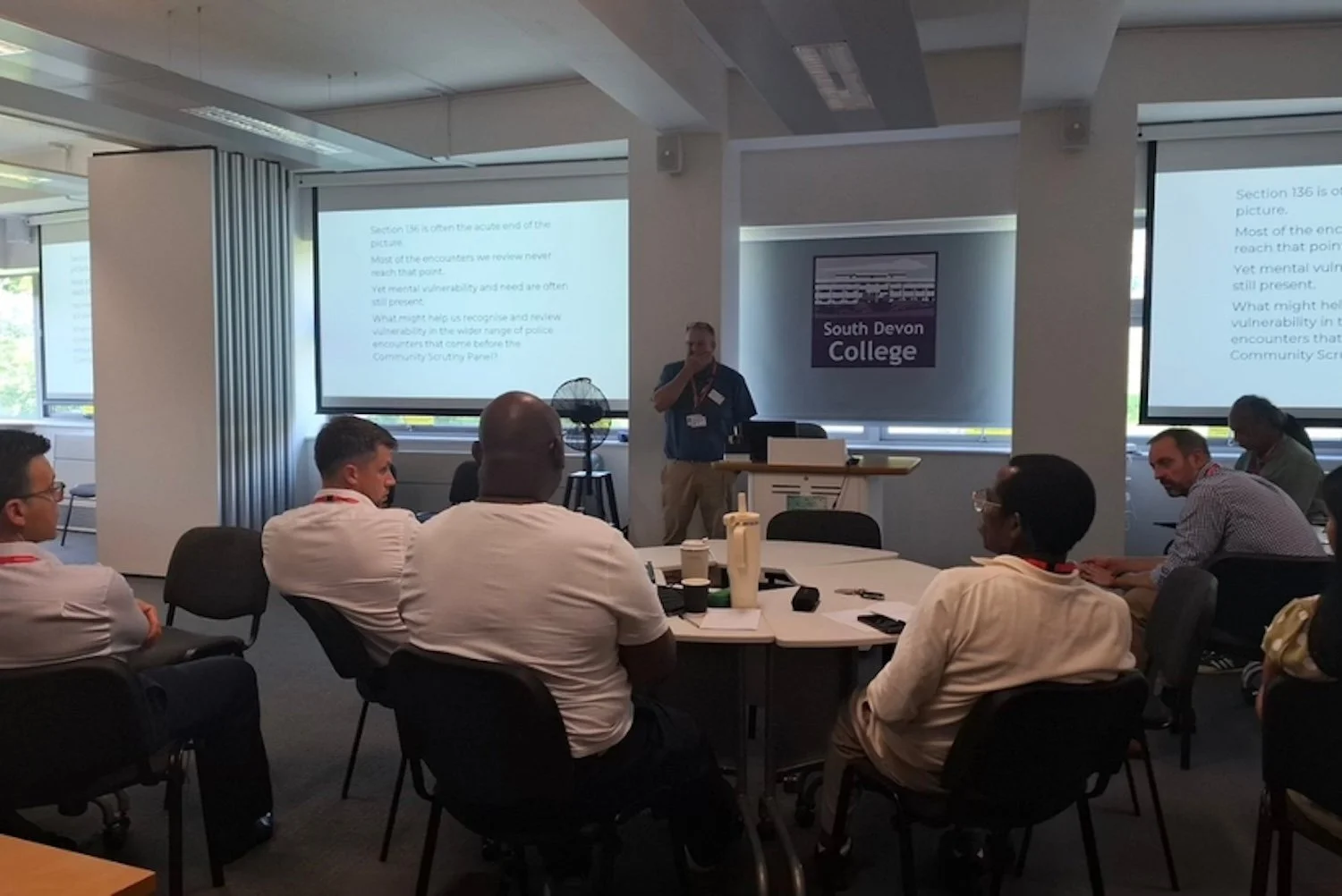
DCCS Panel members along with Chief Inspector Tom Cunningham, Karen Janicka (BWV Subject Matter Expert for Devon & Cornwall) and welcomed new panel members.
This month’s cases were filtered for both Stop and Search and Use of Force.
Before observing body-worn footage selected by the panel from the previous month's cases, the Chair reminded panel members of wellness practice and the opportunity for debriefing at the end of the meeting.
The following report identifies points to action, D&C Police responses, case assessments and outstanding areas that require investigation.
Body-Worn Video Assessment .
Body-Worn Video Assessment .

ASSESSING D&C POLICE STOP AND SEARCH [S&S]
JULY 2026 REPORT (7-9PM)
Body-Worn Videos
Via Microsoft Teams, at the start of each case BWV Systems Administrator Karen Janicka, played the clip selected by the panel before members completed their anonymous assessment, discussed and submitted the below feedback.
Chief Inspector Tom Cunningham circulated this report with actions and recommendations to D&C Police Basic Command Unit, Operations Department, Learning and Development, Force Stop and Search Lead and Force Use of Force Lead.
All confirmed discussions, decisions and/or actions taken by officers and supervisors following receipt of the DCCS Panel report are identified in bold blue text.
Panel members use GOWISELY as part of their scrutiny assessment. It is an acronym that officers must use to provide information to a subject before the Stop and Search. If the GOWISELY procedure is not followed then the S&S is highly likely to have been unlawful.
GROUNDS of the search
OBJECT of the search
WARRANT card [if not in uniform]
IDENTITY [officer name & number]
STATION [where officer is based]
ENTITLEMENT to receipt
LEGAL power used
YOU are detained for S&S
S&S Case 1 - Officers recognised the male and his companion as individuals associated with urban exploring. During a stop and account, they admitted they had been on rooftops in the city centre. Based on intelligence linking them to carrying tools used to gain entry to vacant buildings,
Actions to be commended:
Age-appropriate communication: The panel felt the officer communicated clearly throughout the encounter, explaining each stage of the process in a way that was appropriate to the young person's age and understanding. The officer maintained a calm, respectful and professional manner throughout, appropriately conveying the seriousness of the situation while treating the young person with dignity and respect.
Focus on welfare: The officer demonstrated good consideration for the young person's welfare and dignity, including checking on their wellbeing during the encounter and ensuring the search was conducted appropriately.
Investigation, responses and learning required with:
Retention of mobile phones by officers: The panel would welcome clarification around the circumstances in which a mobile phone can be retained following a stop and search where no arrest has been made. Members were interested in understanding the legal basis and process for this.
Preventative engagement with young people: The panel suggested there may be value in further public messaging aimed at young people about the risks associated with urban exploring. Consideration could be given to using social media platforms to raise awareness of the significant safety risks posed by entering derelict or unsafe buildings.
Response received from visiting BCU Commander
“Jason: thank you to the panel members. I also sit on the Internal Scrutiny and Learning Panel, and this officer has been recognised on a number of occasions for their clear, commanding, and compassionate communication throughout, particularly in dealing with many of the issues we face in the city centre. They handle those matters firmly, robustly, and fairly.
Turning to the question about urban explorers, we have a number of derelict buildings within the city centre, and these present significant dangers and risks. Officers entering those premises must carry out dynamic risk assessments because they may encounter broken glass, flooding, unstable structures, and a range of other hazards. We are therefore very mindful of taking a robust approach to the anti-social behaviour associated with these locations. There is, however, an important distinction between civil and criminal matters. Trespass is generally a civil issue, whereas offences such as criminal damage, burglary, or going equipped to commit burglary are criminal offences.
I don't have the specific details of what our neighbourhood teams are doing in relation to that particular location, but I can certainly find out more information outside of this meeting. I think W raised a very good point regarding the seizure of phones, and that's something we will feed back to the officer. I didn't hear whether the individuals were detained for the purposes of a stop and search. However, if officers were seizing phones as evidence, they would ordinarily need the appropriate legal power, which would typically arise following an arrest; for example, on suspicion of burglary or criminal damage.
If the phones were simply being retained for safekeeping before being handed to parents, there may be a practical rationale for that. However, if the individuals were being investigated for offences such as burglary or criminal damage, my view would be that an arrest should be made first. That would then provide the power to seize the phones, particularly if they may contain evidence such as videos of criminal damage or burglary. It would also provide the lawful authority to examine that material as part of the investigation. It is possible that the officers acted beyond the powers available to them, but that is something I can raise with the officer and provide appropriate feedback on.
Alex: Interestingly, I didn't know this officer before I came to Plymouth, but shortly before I arrived, he appeared on Spotlight talking about the police approach to urban exploration in the city centre. I don't know whether anyone recognised him from that, but he has particular experience of dealing with urban explorers and the officers who have to respond to them, especially the children and young people involved, as they are often the ones entering these buildings and putting themselves at risk of serious injury.
One of the things that urban explorers often say is that they simply want to explore and that their ethos is to "leave only footprints," meaning they don't intend to cause damage. However, they do record videos of what they're doing, so there may well be evidence on their phones showing where they've been and what they've been doing. I therefore agree that it could have been made clearer what the phones were being seized for. That said, I was pleased not to hear the word "mate" being used, and overall I thought the officer came across as very professional.”
S&S BWV 1 ASSESSMENT
D&C POLICE RESPONSE TO S&S BWV 1
Officer’s response not received
Panel response:
S&S Case 2 - Officers stopped a male who matched the description of a suspect reported to have broken into a vehicle and stolen property. He was located within half a mile of the offence shortly afterwards, with no other individuals matching the description in the area. Officers suspected he may have been in possession of the stolen property.
Actions to be commended:
Use of the GOWISELY: The panel felt that many elements of GOWISELY were delivered well, with officers providing the reasons for the stop and search and generally communicating respectfully with the individuals involved.
Communication and engagement: The panel felt the officers remained calm throughout the encounter, treating the individuals with respect and not allowing themselves to be provoked despite the interaction becoming challenging.
Investigation, responses and learning required with:
Description of the individual: The panel sought clarification regarding the description used to justify the stop, particularly around ethnicity and clothing. Members questioned whether the individual appeared to match the description provided and would welcome reassurance that the grounds for the stop were clearly linked to the information available.
Communication and language: The panel noted one comment made by the second officer, understood to be along the lines of "I can do what I want," which was felt to be unnecessary and could have been interpreted as dismissive. Members suggested that maintaining calm, professional language throughout helps reinforce public confidence, particularly where an individual has raised concerns or appears vulnerable.
Narrating the search: As with previous cases, the panel felt there would be benefit in officers consistently explaining each stage of the search as it is carried out. Members considered this to be good practice as it supports communication, reassures the individual, and helps maintain safety for both the officer and the person being searched.
Consideration of vulnerability: The panel noted a reference to medication and possible mental health concerns during the interaction. While it was not clear that further action was required in this case, members felt it would be helpful to ensure that any indicators of vulnerability are appropriately acknowledged and considered during police encounters.
Response received from visiting BCU Commander
“ Jason: I thought the encounter was handled well overall. You could consider factors such as what day it was or whether the officers had already worked a busy evening or night shift. However, that shouldn't ultimately matter, because each individual should be treated on their own merits and receive the same high standard of service, regardless of how long an officer has been on duty. That said, you can perhaps understand the perspective of the second officer, as different officers have different communication styles. Personally, if I were a member of the public, I would probably have preferred to be dealt with by the first officer who carried out the initial engagement rather than the second, but that's simply a matter of communication style.
In relation to the handcuffs, an individual can be detained in handcuffs for the purposes of a search where it is necessary—for example, if there is a risk they may escape, dispose of evidence, or become violent. In this case, the officers clearly made a decision not to continue using those powers, although I can't comment on why they reached that decision. I do completely agree with the importance of talking to people through the search. It helps build rapport, improves communication and ensures the person understands what is happening throughout the process. I think that's a really positive point that we should feed back from both of these encounters.
Alex: One point we discussed was what happened once the search had been completed. The question wasn't intended to justify the use of handcuffs, but rather to understand why the individual remained in handcuffs after the search had finished. At one stage, I wondered whether the officers were considering making an arrest. They may have had lawful grounds to arrest her in connection with the theft investigation. We later learned that the reporting person had witnessed the male breaking into the vehicle, and it's possible the officers were making further enquiries—perhaps contacting the reporting person to establish whether a female had also been involved. If that was the case, they may have been deciding whether she should also be arrested.
Jason: There was also a question about medication and whether enough consideration had been given to the individual's welfare. I think the point raised related to the officer asking about medical or mental health issues during what had become quite an argumentative discussion about the circumstances of the stop. It's a fair question. I'd like reassurance that, if someone was clearly presenting with significant mental health concerns or obvious vulnerability, that would be recognised and acted upon appropriately. In this particular case, however, I don't think there was sufficient information to suggest there was a clear need for further probing.
Finally, I'd like to reinforce the point about the officers' calm and professional engagement. As we've discussed, maintaining a composed and respectful approach is really important. As part of our internal scrutiny work, we've also emphasised the importance of officers narrating the search as it takes place. I've already raised this with our Learning and Training Team so it can be reinforced as good practice, encouraging officers to carry out structured, methodical searches while clearly explaining what they are doing throughout.”

S&S BWV 2 ASSESSMENT
D&C POLICE RESPONSE TO S&S BWV 2
Officer’s response not received
Panel response:
ASSESSING D&C POLICE USE OF FORCE [UOF]
JULY 2026 REPORT (7-9PM)
Body-Worn Videos
Panel members use PLANTER as part of their Use of Force scrutiny assessment:
PROPORTIONATE amount of force implemented
LENGTH of force used
ACTIONS of subject warranted use of force
NECESSARY to use force to protect the subject, officers or members of the public
TYPE used was minimum appropriate
ETHICAL to use force in the situation
REASONABLE for officer(s) to employ
UOF CASE 1 - Police responded after ambulance crews reported that a male who had allegedly overdosed became agitated, chased paramedics from the property, threatened to kill them, and was reportedly armed with a baseball bat. The male refused police entry, threatened violence if officers entered, and stated he had overdosed on diazepam.
Actions to be commended:
Communication and De-escalation of the situation: The panel felt the incident was managed calmly and proportionately given the circumstances. Members recognised that the officers maintained their composure throughout a potentially high-risk situation and did not allow the encounter to escalate.
Investigation, responses and learning required with:Professional language and behaviour: The panel noted comments made by one officer, including a remark understood to be along the lines of "I'm here for the fun of it," together with some laughter between officers. Members felt these comments were unnecessary and could be perceived as unprofessional or risk escalating the interaction.
Use of handcuffs: The panel noted the individual's comments that the handcuffs were tight and suggested reinforcing the importance of checking handcuff comfort and communicating with the individual throughout the detention, particularly where the person is of a larger build.
Number of officers present: Members questioned whether the number of officers in the room remained necessary once the situation had been brought under control. While recognising that a larger initial response may have been appropriate due to the reported risks, the panel suggested consideration be given to reducing the number of officers present where it is safe to do so, to minimise any unnecessary intimidation.
Operational tactics: The panel sought clarification regarding the use of the protective shield during the entry, as some members were unfamiliar with its deployment and were interested in understanding the circumstances in which it would typically be used.
Response received from visiting BCU Commander
“ Alex: I was just going to add some context. It appeared to be a joint deployment involving response officers and Armed Response Vehicle (ARV) officers. In situations where there is intelligence that an individual may be particularly dangerous or have access to a potential weapon, such as a baseball bat, it is not uncommon for specialist firearms officers to attend. They bring additional skills, medical capabilities and protective equipment, including ballistic and protective shields, which can be invaluable in managing the risks to everyone involved. In this case, although the specialist officers attended, they were not operating in an armed capacity.
They were equipped with Tasers and were there to support the response officers. It's also worth noting that the individual had a history of violence, including a previous incident involving threats towards police officers with a chainsaw. That intelligence would understandably have informed the risk assessment and may explain the decision to use protective shields during the entry. I also noted the swearing, which I agree was inappropriate. In relation to the handcuffs, there was a comment that they felt tight. Officers do have the option of using two sets of handcuffs linked together for individuals of a larger build, which can make them more comfortable while still ensuring safety. It may be worth considering whether that option was appropriate in this case.
Jason: I think that's really valid feedback. On the handcuffs, we should continue reinforcing the importance of explaining what we're doing and demonstrating compassion—for example, checking the handcuffs, asking whether they're causing discomfort, and reassuring the individual that they've been checked and adjusted where appropriate. In fairness, when dealing with someone who has a history of violence, it is often necessary to have a number of officers present to ensure everyone's safety.
However, once the situation is under control, it's important to establish a clear line of communication. One officer should take the lead while, if it's safe to do so, the remaining officers step back or wait outside to reduce the sense of intrusion. That said, these situations are challenging. Without being present, it's difficult to judge. If someone has the potential to become violent, it may genuinely require four officers to safely manage the situation and minimise the risk of injury to both the officers and the individual. So I do take the point about reducing the number of voices and having a clear lead communicator, but there is always a balance to strike between effective communication and officer safety.”

D&C POLICE RESPONSE TO UOF BWV 1
Officer’s response not received
Panel response:
UOF CASE 2 - Police responded to a report of a male walking around the city centre carrying a smashed bottle. He allegedly threatened to slash a person's neck after being refused entry to a store and was seen swinging the bottle in the street. Following a 999 call and CCTV assistance, he was located by a PCSO in possession of a new bottle of wine.
Actions to be commended:
Communication and de-escalation: The panel felt this was one of the strongest encounters reviewed, highlighting the officer's calm, patient and respectful communication throughout. The officer consistently explained what was happening, remained composed under pressure and gave the individual every opportunity to engage positively.
Professionalism and teamwork: The panel commended the professional approach taken by both officers, recognising the effective teamwork and seamless support provided during the incident. Members particularly welcomed the consideration shown for the PCSO's welfare and the calm, confident intervention by the attending officer, which helped maintain control of the situation without escalating it.
Managing a challenging situation: The panel recognised the officers' ability to de-escalate an incident in a busy city centre while maintaining a firm, proportionate and respectful approach throughout.
Investigation, responses and learning required with:Role transition and communication: The panel reflected that the PCSO appeared to have the situation well managed before the second officer arrived and suggested that, where appropriate, a smoother transition of lead responsibility may help maintain continuity of communication. This was offered as an observation rather than a criticism, recognising the positive outcome of the incident.
Response received from visiting BCU Commander
“I'm really pleased to hear that, and thank you for the feedback. I think it will go a long way with the officers and will be really motivating for them. I'll make sure it's passed on, it is very much appreciated. The only point I wanted to raise was that, based on the initial report and the fact that the individual wasn't supposed to be drinking in the town centre, I think I would have liked to see an earlier decision to arrest. There was quite a long period spent trying to engage with him, whereas I felt the circumstances may have justified bringing him in sooner. I appreciate there were practical issues, such as difficulty getting through on the radio, and that it was a busy period.
I also recall that the last time we reviewed body-worn videos together, we made a similar observation. Sometimes there can be quite a long period before decisive action is taken, and during that time there can be increased risk to the officers, the individuals involved and members of the public. On occasion, less is more, and acting more promptly can be the safest option. I really value the opportunity to hear everyone's insights, as that's what these sessions are all about.”

D&C POLICE RESPONSE TO UOF BWV 2
Officer’s response not received
Panel response:
“Thank you all for your time this evening, and thank you for your service. Without sounding corny, I genuinely appreciate your time, your openness and the clarity of your answers. We are here to learn. I just want to reiterate that we scrutinise what we see on the body-worn video, recognising that there is often context before and after the footage that we don’t have. I think that comes across in the feedback we provide. Thank you again, we really appreciate your time. ”
Legal Requirements
Officers are mandated to switch on their body-worn video (BWV) cameras from the beginning of any incident. During a Stop and Search, officers must provide specific information to the person being searched. While there is no strictly prescribed order, the College of Policing recommends using the mnemonic GOWISELY to ensure all statutory elements are covered.
For Use of Force, the College of Policing toolkit outlines PLANTER as a structured approach to ensure actions are justified and proportionate.
What is Procedural Justice?
Panel members score each BWV case using a consistent academic framework to inform how well the officers did in meeting legal requirements but also in the way they treated the person being stopped. Procedural Justice involves the pillars outlined below:
Voice: Was the subject allowed to give their side of the story or ask questions (within reason)?
Neutrality: Were the officer’s decisions unbiased and guided by transparent reasoning?
Dignity and Respect: Was the subject treated with courtesy and respect throughout the encounter?
Trustworthy Motives: Did the officer seek to explain and encourage understanding?
Accessible communication: Was the language used clear and easily understood by the subject?
Appropriate Tone: Was the tone of voice calm, respectful, and suitable for the situation?
Interested in making a difference?
Improve accountability, transparency and trust between D&C Police and the communities they serve.
Receive free training, work alongside inspiring individuals and help make positive changes.
Scrutinise Stop & Search and Use of Force, or join sub-committees to share your skills or learn new ones.